Posts

Hybrid

I had a Friday reflection all set to send out this week, but I'm switching directions after our School District's board   meeting about our potential move into hybrid.  Most of us have found a comfortable rhythm with virtual learning - and   now a big wrench is thrown into it.  The introduction of Hybrid is on the calendar and it is indeed a daunting task. We   know there is no template for moving forward - not neat little grid where we can fill in the boxes - no clear cut roadmap.   Several staff members shared the following concerns: Can we keep students socially distant in our spaces with our current resources? Will my current class list go to the wayside after I just spent a month building camaraderie?  Will teaching assignments be shifted to different grades? different schools?  How do I protect the vulnerable people in my life? Is there a concrete statistic that will be using to make the call on staying remote, going hybrid, and going back r...

Caroline and Kim

Image
So where are we at in the middle of September?  Where are you at in the middle of September? I venture that we are questioning certain aspects of our school day and feeling good about other parts.  One of the biggest concerns for me is the gnawing concern about our youngest students.  Primary grade kids are participating well but will they learn to read etc through zoom lessons?   One thing I'm feeling good about is the presence of students. I love seeing the few kids who are in the building. How did it happen that these few kids were brought into school?  It happened because their educators insisted on it.  Caroline along with Kim made it happen for the kids in their structured classroom.  They knew their kids would be frozen, even regress, without spending in person learning time with them.  So, Caroline sent out a survey to her parents before school even started asking for their comfort level with having their kids in the building. Next, C...

Michelle

Image
Another week under our belts.  I’ve continued my journey into classroom zooms and have been impressed with what I’ve seen.  It’s inspiring to think how far we've come in such a short amount of time.  But, one glaring missing component in my observations in this virtual world is “learning with others”.  If the kids were in person, I would see students learning and interacting with their peers all over the school;  hearing teachers say “turn and talk to your partner about XYZ” was just as common as hearing the lunch bells. Recess, lunch, Friday fun time, classroom parties, and so on were times where students were able to socialize with each other without teachers orchestrating the dialogue of the group. Interacting with peers is a huge deal in the elementary setting.  Students need to “click” and make friends with the other students in their class.  The skills we learn from forming friendships in elementary school lay the foundation of how we relate to o...

Tyler and Rosemary

Image
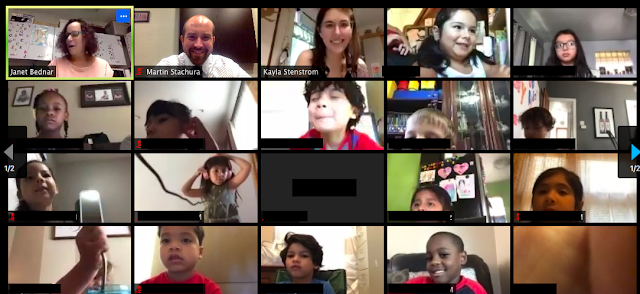
Another week has come and gone.   Last spring when the end of the school year was in sight, virtual learning seemed more manageable. Now -we see no definite end in sight. It’s a new ballgame on a different playing field, and we don’t know what inning we are in. But we are showing up each day for each other and for our kids.  It’s obvious to me that we are getting our footing.   I went into Tyler and Rosemary’s classroom this week to get a deeper understanding of the complexity of our new way of teaching. By sharing what I saw, I hope you might gather some insight that may help you with the dynamics of virtual learning. Connection: They begin with a “Good Morning” greeting - greeting each student as they pop into the zoom. When announcing each individual student, they referred back to a personal tidbit that the student shared earlier in previous days: for example, “Sean, how is your dog, Rubble?”   Student Behavior Expectation: Students were reminded ...

Janet and Kayla

Image
We have begun!  And, full steam ahead!  So much sound “stuff”, staff.  We are charting our path forward, and we will need to monitor our path and adjust our focus and our directions.  All of us know that.  We must give our time and space to learn how best to teach our students virtually.  ISBE recommends that districts strive to provide students with at least 2.5 hours of “synchronous” learning with real time instruction and interaction between students and teachers.  We need to break down the meaning of the word “synchronous”.  I am taking a broad definition of their recommendation - that is, we need to put on our teacher hats and know that much of what you will be doing with your students - e.g. mini lesson on key concepts along with student interaction around the concept and students applying the main concept independently - all examples of synchronous learning.  Let’s not get stressed out and hung up on spending 2.5 hours of our day direc...

Rebecca

Image
Rebecca and Nicola have worked since the beginning of the year to manage the behavior of one of their more challenging students.   As is often the case, a co-taught classroom offers additional support and focus that is not available if a teacher is working solo. Rebecca and Nicola realized that because Rebecca had built a stronger rapport with the student, Rebecca would work on a protocol to address the student’s needed behavioral skills in order that he and all the students moved forward.  From my perspective, Rebecca’s early path with this particular student was rocky. Early on, she approached any misbehavior with positive reinforcement type comments - possibly because she was coached by colleagues that this approach had worked with Jayden in the past.  But she could see that misbehavior continued and this approach was communicating to Jayden that his behavior was ok - which it wasn’t; perhaps, he somehow viewed that she had low expectations of him - and so he...

Alex

The district professional development on “Trauma-Informed Teaching Approaches” provided us some insight into a deeper understanding of our most challenging kids.  The first and most important take a-way from this approach is that the kid who’s pushing against you is probably the kid who needs you the most.  This is the kid who has somehow internalized “I’m bad”  “I’m not good enough” and often these kids come to us with a history of manipulation, coping mechanisms meant to cover up inadequacies, attention getters that aren’t socially appropriate, and on and on.  These are not bad kids – they are kids with serious needs.  The first big commandment of this trauma understanding reminds us:  Build a relationship with these students . They need to know the teacher likes and respects them, because many of them have not been able to trust authority figures...